Title
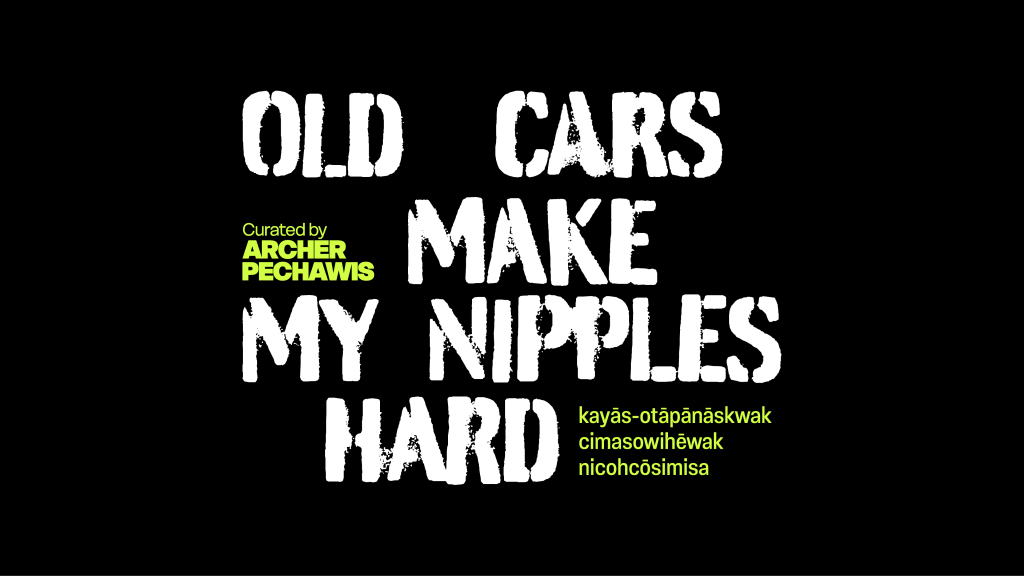
Old Cars Make My Nipples Hard (kayās-otāpānāskwak cimasowihēwak nicohcōsimisa)
Dates
April 9, 2026 to August 9, 2026
Vernissage
April 9, 2026 at 2 p.m. EDT
Curator
Archer Pechawis
Artists
Lawrence Paul Yuxweluptun
Funder
Social Sciences and Humanities Research Council (SSHRC)
Social Sciences and Humanities Research Council (SSHRC)
“Old Cars Make My Nipples Hard” (kayās-otāpānāskwak cimasowihēwak nicohcōsimisa) takes on the challenge of transmediating artworks created with obsolete media. A member of the Mistawasis Nêhiyawak in Saskatchewan, Pechawis works at the intersection of Plains Cree culture and digital technology. Leveraging the affordances of current technology, this exhibition gives visitors the opportunity to experience Lawrence Paul Yuxweluptun’s 1997 performance “An Indian Act Shooting the Indian Act”, watch videos that were previously trapped on a CD as QuickTimeVRs, and enjoy a new installation that simultaneously reflecting Pechawis’ punk spirit and his family heritage.
Essay
Below are a collection of texts, including an interview and two essays written by Sara Diamond specifically for this exhibition.
Interview with Archer Pechawis and Sara Diamond
Sara: Your show is called Old Cars Make My Nipples Hard. Let’s talk about why you decided you wanted to have this fabulous gravity-defying junkyard of cars.
Archer: It’s an homage to my Uncle Harvey, who’s my last remaining uncle of six. And his yard on the reserve is just an ocean of old cars. I think it’s gorgeous. It’s a beautiful place. There’s all manner of farm vehicles, old campers, old cars, old trucks in various states of collapse.
There’s this deep love, especially in my generation and in my parents’ generation of 1960s American cars, those big, powerful, dangerous American cars. I hadn’t considered it as a design element, but then Skawennati’s team assembled all these old cars–to my delight. When I saw them in the gallery, I said, “This is fantastic, more cars!” And the gravity-defying thing is lovely too. Defying physics is always nice.
One of the pieces, “Trad” (“Traditional”) includes screen grabs from a video I shot in a junkyard in southern Alberta, about two hours out of Calgary. It was 50 acres of old cars. I love junkyards. And they’re a vanishing breed. It was like dying and going to heaven.
Sara: How does bringing back old cars relate to retrieving the archive of old media, of former forms of media, former artworks? It seems like such a great metaphor for thinking about discarded media.
Archer: They’re discarded cars, but depending on your perspective, they’re not discarded. They’re waiting. They’re waiting for someone like me to come along, take them to some garage space and rebuild them, which is what we’re doing in Second Life. To me, they’re not junk or garbage or landfill, but rather, each old, discarded vehicle is a treasure trove of possibility.
Sara: I grew up with a father who drove his cars for more than 20 years until they became beaters, and would literally fix the fanbelt with my mother’s stocking.
Archer: This is precisely the subtext of the homage to my Uncle Harvey. He’s that guy. He can fix anything with a nail and some baling twine. I’ve always admired that and wished to emulate it. I do that kind of work around media, right?
The beauty of the project is to take these entombed media works that we all have, you know, frozen in time in these obsolete technologies and revivify them.
Read the accompanying essay PILING THEM UP .
Sara: I want to walk through each work. Can we talk about “Trad”?
Archer: There are four videos in separate spaces and there are the installation panels around these as well. The interviews came from my first digital drum performance in 1997 at the Western Front, “Memory”. The messages were so powerful, I wanted to repurpose those videos into a different project. When Oboro offered me a QuickTime VR workshop, I dove in and started exploring the technology and what it was and what its limitations were. You remember how hard it was back in the day to stream video from CD-ROMs when everyone had like a 1X and a 2X and a 3X playback device, right? So, there were a lot of technical hurdles, which I overcame.
Sara: What does “trad” mean now when you watch it decades later?
Archer: The elders are Bill Lightbown, he was Kutenai, and Tseybayotl-t AKA Harriet Nahaney, from the House of Pacheedaht , who are part of the Nuu-chah-nulth peoples.
It’s especially poignant because both Bill and Harriet have passed. It never occurred to me when I was video recording them how much of an impact their words were going to have on me and the way I conduct myself in my life, which has turned out to be profound. It was prescient. Especially Harriet talking about listening to your soul, that’s become a cornerstone of my artistic process. I tell people all the time, I don’t have ideas. I get my ideas from my ancestors, and I just do them.
Sara: People might forget or not know how activist the 1970s and 80s were in terms of Indigenous cultural and political militancy. British Columbia was roiling with land- and water-rights protests, actions to control education and gain self-government, and protests against the corruption of the Department of Indian Affairs. There is continuity there as well.
In the Two-Spirit segment, you ask the elders about how they see two-spirited identity. Why did you ask that question? Were you pushing them a bit?
Archer: It was more about curiosity. The term Two-Spirit was relatively new at that time; it wasn’t in general usage in the communities, right? It was in general usage in the urban Indigenous queer communities, but not necessarily back home.
When Bill said, I’m not familiar with that term and I said, “We’ll call it … queer Indians”, he came out with this beautiful statement, “We’ve always had gay people who were part of the community”.
Sara: Can you describe the original 1997 performance where you integrated the videos?
Archer: In the original piece, “Memory,” the videos played, and then I sang a song in response, and did that four times. It was very formal. It started in the east, went to the south, went to the west, went to the north.
Sara: You don’t have the call-response in Second Life.
Archer: Although you could say, Sara, that the call is the interaction of the user. In “Trad”, the Quick Time VR installation, the panels were non-interactive, it echoed the first Memory piece in that there was a clickable panel to the east, and then static panel, static panel, static panel, clickable panel to the south, static, static, static through the directions. With QuickTime VR, if you’ll remember, you could pan up to a certain point, but you couldn’t do a full 360, right? It was just up to here, and that was the ceiling. And then down to here, that was the floor.
I was there at the birth of Lawrence’s “An Indian Act Shooting the Indian Act” performance because we’d have dinner at Glenn Alteen’s [Director of Grunt Gallery] place and Lawrence inevitably would start hacking on performance art and what a bunch of crap it was, right? We’d have these hilarious debates. And then Lawrence goes, “Yeah, I’m going to do a performance where I shoot the Indian act. And he meant it completely sarcastically. And Glenn dove on it. And I thought, oh my God, this is going to totally happen. And it did, of course. So that was the genesis of “An Indian Act Shooting the Indian Act.”
They did a great job of how they documented the performance, but the motherload of ephemera that came out of the piece: gorgeous, boxed shotgun shells and decommissioned rifles!
Sara: I was reading about the different responses to the work in the UK in Glenn Alteen’s article “A Hard Act to Follow ” https://archives.grunt.ca/Detail/objects/7160 and how it didn’t become a conversation about colonialism and the Indian Act in the UK; it became about hunting and about using guns in the UK, both of which are privileges of the rich. And then it comes to Canada, and it becomes quite notable and controversial because it’s really about the Indian Act. Saul Terry’s article “Why Shoot the Indian Act” https://e-artexte.ca/id/eprint/19246/ is also powerful. He is a former Grand Chief of the Union of BC Indian Chiefs, during a time of intensive activism, as we were saying way earlier. He talks about how the Indian Act was a force of destruction.
Archer: I was commissioned by Grunt Gallery to make a CD-ROM document of Lawrence’s performance “An Indian Act Shooting the Indian Act.” How do I transpose the elements from the CD-ROM piece, which was very much a standalone work documenting Lawrence’s piece? I was very proud of the interactivity of the CD-ROM, how it worked. You remember when Flash books came out? That was like the big, exciting thing. So, it was a Flash book. When you rolled over a clickable link, you got this rifle scope that would magnify the target, the link. You would get the audio of the bolt of a rifle being shoved home. And then when you click, you’d get the rifle shot. And that was the navigational metaphor throughout the piece. It took me so long to make that work.
Sara: How appropriate to bring the conversation about the Indian Act back as we near the 150th anniversary of the Indian Act on April 12, 2026. Did you propose this to Skawennati or did they say they wanted to revitalize that artwork and your contribution around it?
Archer: It was really a pragmatic decision. I thought, “Trad” for sure. And then “Shooting the Indian Act,” because I have a little stack of the CD-ROMs. I had physical media to work from.
Back to your question about the Indian Act; this is a question that just gets increasingly relevant. Why are we being governed by this ridiculous colonial artifact? But then it comes down to, what’s going to happen? There’s this whole love-hate relationship with the Indian Act. On the one hand, it’s an instrument of oppression, on the other hand, it is the only thing that preserves the rights that we maintain. The federal government’s trying to municipalize First Nations governance, which is not a good thing for us at all. They are trying to bypass self-government by saying, well, we’re going to change the Indian Act and give you all these powers.
Sara: Why is that important, in the context of both Indigenous creative practises and overall culture, to bring back these new media works?
Archer: They’re telling documents of a time. They’re little time capsules. Both have become surprisingly more relevant now than they were when they were made. It is akin to the people at Rhizome who have ported CyberPowWow to revivify it. Whereas we thought it was lost forever, but now it’s back! You’ll relate to this wholeheartedly. We make these artworks and we’re not always cognizant of how important they might become in the history of media art or artworks or Indigenous art or whatever the context is.
Read the accompanying essay LET US TRANSMEDIATE.
Sara: I completely agree with you about also understanding the technological evolution of these media and the affordances. How do you see Second Life as a context for audience?
Archer: This is the first time I’ve had anything to do with Second Life. Skawennati has been trying to drag me into Second Life for decades. I didn’t think it would last. I thought, ‘I’m not going to invest in a platform that’s going to be dead in five years.” So, the fact that Second Life is still rolling, what is it, 20, 30, however many years it’s been around, is impressive, right? This is worth investing in. The magic of CyberPowWow was the local involvement. It was the meeting spaces that we created in so many geographically removed spaces and how much fun those things were.
It was about 70% Native people that came out to the local spaces, and the majority of them weren’t Internet savvy. They weren’t interested in Internet art per se. They came because it was a cultural event. A big part of the local event was teaching people how to use the software, how to navigate through the space, how to make an avatar, how to do those things.
I don’t know how much you know about Powwow culture, but in Powwow culture, if someone loses a feather from their regalia, everything stops, and there’s a whole process–a ceremonial process–that takes place to restore the feather to where it’s supposed to be, and that’s part of powwow. I think it was the second CyberPowWow. We had a space at Tech BC. Ryan was our server guy. He was our caretaker, our babysitter. And the event happened on a Sunday. Ryan was in Calgary, and the server went down in the middle of CyberPowWow. The server just barfed. The server is configured to reboot, but there was 10 minutes of just dead air. And then the server rebooted, the Palace came back online, yay, and the event continued. And a participant came up to me, and he said, “You know, Archer, when the server crashed, that was when the eagle feather dropped. And I was like, ‘Oh, dude.’”
I find there’s a bit of a sterility to Second Life that I don’t really care for.
Sara: You’ve introduced the junkyard, so you’ve hit that sterility head-on.
Archer: You’re not expecting to come into Second Life to walk into a junkyard. Yes, so it’s a rusting place and a resting place.